
So the best option by far from the GHG perspective is to buy a more fuel efficient second hand car, but even a second hand electric car pays off after the first year, and a brand new petrol car or battery powered electric vehicle both pay off after only 5 years.
I have a friend who gives me a lift to local CSA Big Meadow a few times a month. Over the last few weeks she has had to get her 2007 Vauxhall Zafira sent in for repairs and during our shared car journey the topic of whether it is better to buy a new car or keep the old one came up.
My automatic response was that it is much better to get rid of the old car and get a new electric or fuel efficient vehicle, whereas she felt that, because of the resources involved in manufacturing a new car, that it would be better to keep the old one and run it into the ground before buying a new one.
It’s a question that I guess many people probably ponder and so I thought it would make an excellent basis for a blog. Individual car travel, at the end of the day, does have a high carbon footprint, and typically contributes about 20% of an individual’s carbon footprint, and around 10% of global greenhouse gas emissions. Although getting rid of the car is probably the best option, it is not a feasible option for many people, and indeed even when it comes to strategies to reduce global greenhouse gas emissions, reducing car travel is not necessarily the most effective approach. To give a classic example, you could increase the amount of car travel globally by threefold, and still reduce global emissions if you made those cars 5 times more fuel efficient. So while getting rid of the car still represents the best option, the next best option (and the most realistic strategy to reduce emissions) is without doubt to ensure your car is as fuel efficient as possible.
But is it worth buying a new electric or fuel efficient car when you already have an existing car? Many people would think that it would be better to keep the old one, to ‘reduce and reuse‘, but in fact, when it comes to cars it is fuel efficiency that is the biggest determiner of how much pollution you are creating, because petrol or diesel has such a huge carbon footprint.
To demonstrate this, I will use the example of my friend’s 2007 Vauxhall Zafira and compare it to a new petrol car, a used petrol car, a new battery powered electric car, and a used battery powered electric car.
The table below has three main columns, one for the existing car (orange), one for new and second hand medium sized petrol cars (purple), and one for new and second hand medium sized battery powered electric cars (green). I did not consider diesel cars because petrol cars are generally less fuel efficient than diesel, so if it turns out that it is better to replace the existing car with a new petrol car, for example, then it will definitely also be the case to replace it with a diesel car, but the opposite would not necessarily be true.
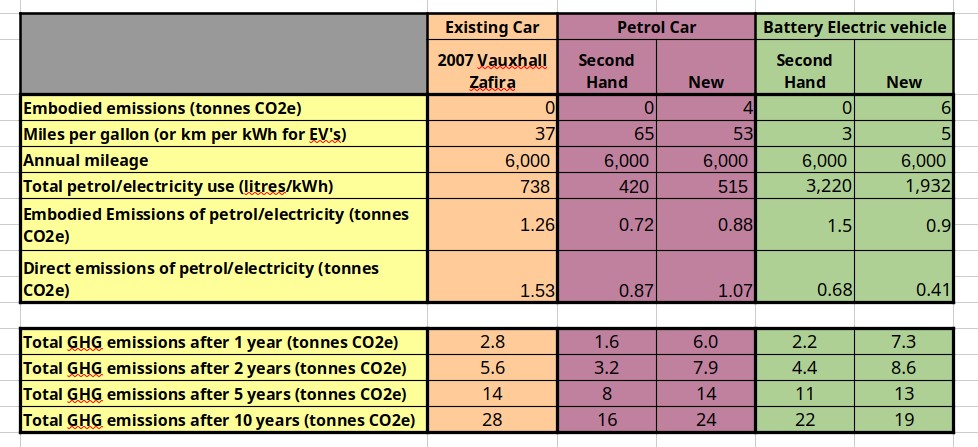
So the first row represents the embodied emissions of the car [1]. This is all the greenhouse gas emissions that result from the manufacture of the car, including the whole supply chain, such as the mining and transportation of all the materials, and so on. Modern manufacturing and mining methods are very efficient, and so this does not amount to as big a figure as people think. For a typical new petrol car this amounts to about 4 tonnes CO2e, and for a new battery powered electric car 6 tonnes CO2e. And of course, for second hand cars the embodied emissions are zero, as they already exist and have not been specially manufactured for the consumer.
Next comes the fuel economy for the cars. For petrol cars this is miles per gallon, and for electric cars this is km per kilowatt hour (kWh) [1]. I took a high figure for the second hand petrol car (but by no means the highest fuel economy available), as I felt that if you were going to buy a second hand car to replace the existing one then you would specifically choose a high fuel economy. The figure for the new petrol car represents the average fuel economy of a new car in the UK for 2025 [3]. The figures for the second hand electric car represents an average for battery powered electric cars in the UK [1], whereas the figure for the new battery powered electric car represents a more efficient model (though by no means the most efficient, which can come in at 8 or 9 km per kWH).
In the third row I assume an average annual mileage of 6,000 miles, and in the fourth row I calculate the total amount of petrol or electricity that has been used based on that mileage.
In the fourth and fifth rows I calculate the embodied emissions [4] from using all that electricity or fuel, and then the direct emissions [5]. To give an example for explanation: the direct emissions for using electricity represent the emissions created at the power station from burning fossil fuels, whereas the embodied emissions represents all the behind the scenes processes that has to happen and infrastructure that has to be built for those fossil fuels to be mined, refined, distributed and burned and for the electricity to be distributed (think of all those pylons, cables and substations).
As you can see from the fourth and fifth rows of the table, the embodied emissions from using electricity are more than double the direct emissions that result from burning fossil fuels at the power station to produce that electricity, whereas for petrol the embodied emissions are less than the direct emission that result from burning it. This is important, as typical km per kWh or mpg quoted by car companies do not include the embodied emissions, and this tends to paint a slightly false picture that favours electric cars. So this is an important correction, but as we will see it does not effect the final result.
So in the final rows I add up the embodied emissions and the direct emissions of the electricity or petrol used, and also add on the embodied emissions that result from manufacturing the new cars, to get a final figure that we can then compare.
Obviously the final result depends on how long you run the car for, so in the table above I quote the results after 1 year, 2 years, 5 years and 10 years. As is expected, buying a more fuel efficient second hand petrol car has immediate savings, and after 5 years those saving amount to an appreciable 6 tonnes CO2e, and after 10 years, a whopping 12 tonnes CO2e.
It may be argued that the old car would be sold and someone else would drive it, thereby creating all that pollution anyway, but from our perspective, the old car may be purchased by someone and used to replace an even more polluting older car, which would then save emissions. The fact is we don’t know, so for our purposes the equation focuses on the known variables. If everyone, after all, makes car purchases based on GHG considerations, then the net result will be reduced emissions.
Also, it is worth adding that one option would be to scrap the Zafira, in which case it would be recycled. The emissions from recycling a car are negligible compared to manufacturing or running it, and so this would not change the above figures and would ensure that it is not being used by someone else to replace a more fuel efficient car.
So the best option by far from the GHG perspective is to buy a more fuel efficient second hand car, but even a second hand electric car pays off after the first year, and a brand new petrol car or battery powered electric vehicle both pay off after only 5 years. So all told, the low fuel economy of the 2007 Zafira really counts against it*, and so if GHG emissions are the only consideration, then the beloved old car needs to be retired and more fuel efficient cars embraced.
*(Worth noting however that in the US this Zafira would be a high fuel economy vehicle, as standards there are truly appalling, with an average of only 26mpg in 2022 for new vehicles.)
Even if you decide to question the figures for manufacturing the new petrol and electric cars, and increase them by 50%, this still does not significantly affect the final result. All the results remain the same except that a new electric vehicle will pay off after 7 years instead of 5.
It might be argued that the above figures do not include having to replace the battery for an electric car, but according to Tesla [6] a battery for an electric car retains 90% of its life after 200,000 miles, so based on this limited study a new battery would not be needed, but even if it were, it is only going to add around 2 or 3 tonnes CO2e to the final figures, which does not significantly affect the conclusions reached as the Zafira clocks up about 3 tonnes CO2e per year based on a mileage of 6,000m.
What would happen if we reduced the average mileage?
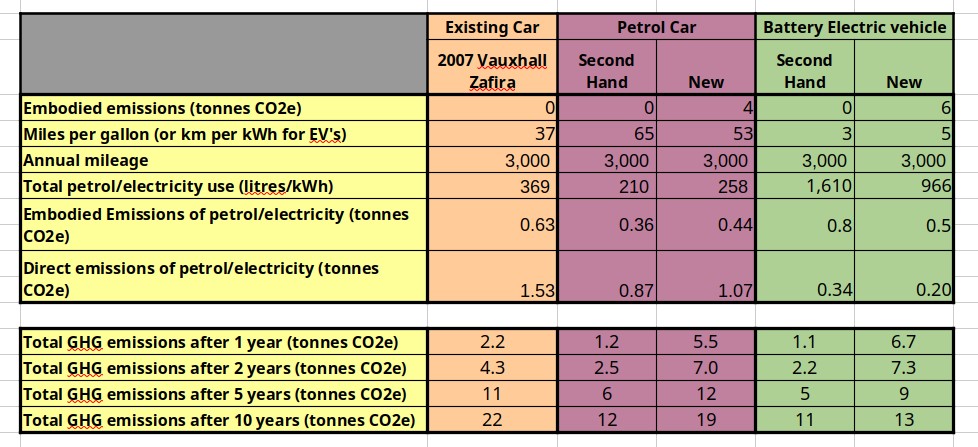
In the above table I have reduced the mileage to 3,000m. Again, as expected the more fuel efficient second hand car pays off immediately, and after 5 years saves 5 tonnes CO2e. The second hand electric car also pays off immediately, and after 5 years saves 6 tonnes CO2e, and even a brand new electric car still pays off after 5 years. This really highlights I think how important fuel economy is for cars rather than the energy or materials embodied in their manufacture. The material cost of producing and burning petrol or electricity is not visible, and so most people mistakenly assume that manufacturing a car is the biggest and most resource intensive part of the lifecycle, but this is a misconception, as the biggest component of GHG emissions by far is the running of the car and the embodied and direct emissions of the fuels used, and this is why fuel efficiency reigns supreme as the number 1 factor to consider when it comes to deciding whether to buy a new car or replace the old.
In the last table below, I revert to an average mileage of 6,000m but increase the efficiency of the electric vehicles to 5km/kWh for second hand and 8km/kWh for new. As can be seen, the overall result does not really change much, except for the fact that the second hand electric car now outperforms the second hand petrol car.

Afterthought
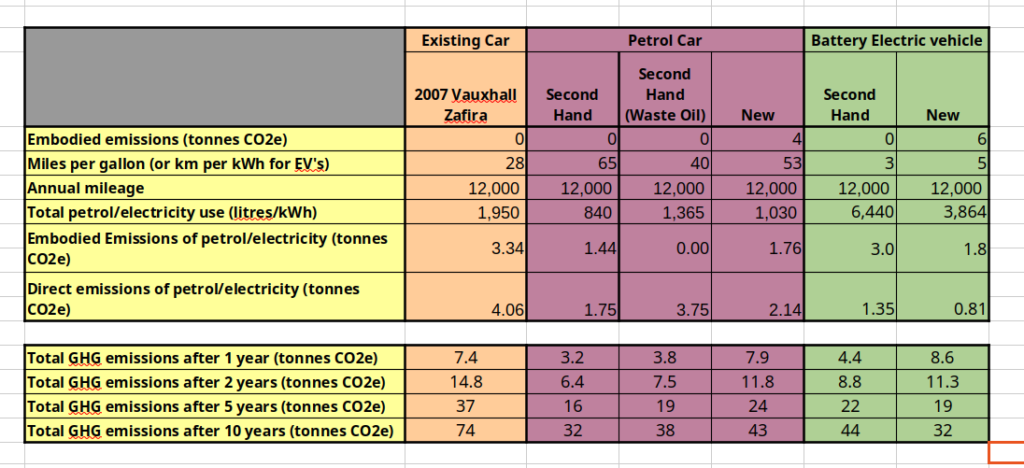
After posting the blog and sending it to my friend who owns the Zafira she then responded asking me if I could up the mileage to 12,000 as she does way more than 6,000 miles. She also gave me her own figures on her petrol use which turned out to be 28mpg when you also factor in the fact she has a roof rack which reduces efficiency, and lastly she asked if I could include waste oil as a friend of hers runs his car on used vegetable oil and also wanted to know how that compared.
So I ran the numbers again and the answers are given in the table below.
Some brief comments:
- I put the embodied emissions for the waste oil as zero as the oil was manufactured and grown for a totally different purpose and would have been thrown away if it wasn’t re-used as car fuel.
- A second hand fuel efficient car has half the emissions of the Zafira. In the first year, with an annual mileage of 12,000 miles and a petrol price of 148p per litre, this would save £1,642.80. That’s a pretty impressive saving!
- I assumed that the car run on waste oil had a fuel efficiency of 40mpg. If it is an old car like the Zafira it will probably be worse, but on that fuel efficiency it comes out as worse than a second hand fuel efficient car run on petrol. The emissions factor for waste oil is higher than for petrol [5], so it is more polluting than petrol as far as what comes out of the exhaust pipe is concerned. Of course, you could argue the emissions are zero because of the fact they are biogenic, and for official carbon footprinting purposes this would be how you would formally account for them. However, many scientists argue that you should not consider biogenic emissions as zero carbon because in the timeframe required to reduce global emissions the planetary biosphere will not have the time to reabsorb them, and so if the aim is to reduce global emissions to net zero by 2050 and avoid the 1.5C tipping point, then you ought to count them. So I went with the latter position, and on that basis it is worse than a fuel efficient second hand car being run on petrol.
- Even a brand new car with average fuel efficiency out performs the Zafira on emissions after only two years, even when you include the emissions that come from manufacturing, mining etc. Also, after 5 years the new car will have saved you £7,000 in petrol compared to the Zafira, and after 10 years, £14,000. In short, it will pay for itself and save the climate!
- Even a brand new electric car will out perform the Zafira on emissions after only 2 years. It will also save you £2,000 a year on petrol, assuming 25p per unit of electricity.
- A second hand electric car has almost half the yearly emissions of the Zafira and will save you £1,300 a year on fuel costs (I assumed the second hand electric car to be less efficient than a new one).
I think the thing that really stands out here are the cost savings, which are truly impressive. As an example, you could buy a second hand Suzuki Celerio with a fuel economy of 78mpg for £6,000, and it would only use 700litres of petrol a year, which comes to £1,036 or £20 a week, saving £1,847 a year on petrol compared to the Zafira. After three years the car has it has paid for itself, so if it was bought on a monthly direct debit then you would not be paying any extra money as the savings on petrol would pay for the monthly payments. In fact you could buy a brand new Celerio and it would pay for itself after 4.4 years, and again, if you paid for it by monthly direct debit you won’t be paying any extra money as the monthly debit will be covered by the fuel savings.
Even a second hand electric car, bought for £10k, would pay for itself after 8 years.
So I think there is no doubt that the old car needs to be ditched asap and replaced by something much more fuel efficient, planet friendly and a darn sight cheaper to run!
[1] The UK: A Low Carbon Location to Manufacture, Drive and Recycle Electric Vehicles.
[2] https://www.fuelly.com/car/vauxhall/zafira/2007
[3] Fuel economy of new cars in the UK (2020), Department of Transport.
[4] https://www.sw-consulting.co.uk/mrio
[5] https://www.gov.uk/government/publications/greenhouse-gas-reporting-conversion-factors-2024
Leave a Reply