There does seem to be a lot of confusion over this issue in the mainstream media and among the general public, largely caused it seems by looking at discrete and incomplete parts of the life-cycle of battery powered electric vehicles (BEVs) and regular cars (ICEs – internal combustion engines).
Two papers published in 2021 however answer this question definitively by looking at the full lifecycle emissions associated with BEVs compared to regular cars. The first [1] is an article published by The Faraday Institution that discusses in detail why driving BEVs in the UK is by far and away the lower carbon option comparted to regular cars, and the second [2] is a paper commissioned by the Department of Transport that does a full lifecycle analysis of UK road vehicles and also comes firmly on the side of BEVs.
The long of short of it is that the question of whether battery powered electric vehicles (BEVs) are a low carbon option compared to regulars cars depends on what country you live in. Electric vehicles, at the end of the day, use electricity to run, and so whether they are low carbon depends on how carbon intensive that electricity is. If the electricity is generated largely by coal powered fire stations then BEVs may not be a low carbon option and you may be better off with a normal car.
The good news, however, for those who are unable or unwilling to give up their car is that in the UK and Europe a substantial portion of the electricity mix is generated by renewables, which means that using BEVs is without doubt the lower carbon option, and by a very substantial margin.

The graph above answers the question definitively, showing that regardless of whether you consider small, regular, or large cars, due to the UK’s very clean electricity mix a typical BEV is estimated to save 65% GHG emissions compared to an equivalent conventional petrol car. I mean, that difference is huge, and as the graph shows, it gets bigger the bigger the car.
Interestingly, the graph above also shows that initially BEVs are higher carbon than regular cars, mainly due to the greater emissions involved in producing the electric battery. Once you include the emissions involved in driving the cars over their lifetime however, then it quickly becomes clear that in the UK, with 40% of the electricity mix being generated by renewables, BEV’s are substantially lower carbon than regular cars.
The graph below shows this facet of the lifecycle emissions of BEVs compared to regular cars even clearer, as the more miles you drive a BEV the greater the disparity in emissions with regular cars gets (worth emphasising again that this is for the UK with an electricity mix that is 40% renewable).

This disparity between BEVs and regular cars is set to grow ever bigger as the UK electricity mix becomes less and less carbon intensive as more renewable energy is deployed. The graph below shows how the carbon intensity of UK electricity generation has plummeted dramatically since the early 2010s, and that this trend is set to continue, with another substantial drop occurring over the next 10 years.
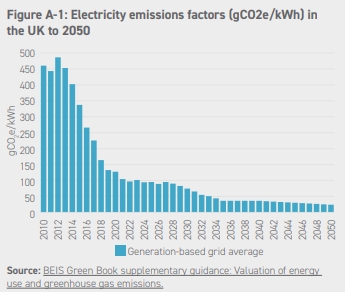
In fact by 2030 BEVs are estimated to deliver a whopping 76% GHG reduction compared to an equivalent conventional petrol car, mainly due to a combination of improved battery technology and a further decarbonised UK electricity grid. By 2050, these savings could increase to 81%
As an interesting aside, the carbon emissions associated with BEVs can be reduced still further by choosing a country with a low carbon intensity of electricity generation in which to manufacture the electric battery. As the graph below shows, a BEV driven in the UK but with a battery manufactured in Poland would have a carbon footprint 40% higher than the same EV driven in the UK but with a UK manufactured battery.

With the carbon footprint of global manufacturing becoming an increasingly important commercial factor, choosing a country with a low carbon intensity of electricity generation is going to become an ever more important priority. This places the UK in a very advantageous position, and also gives another important reason for governments to decarbonise electricity generation, as those countries with high carbon intensity electricity generation are likely to be left behind in today’s globalised marketplace.
[1] The UK: A Low Carbon Location to Manufacture, Drive and Recycle Electric Vehicles.
Leave a Reply