Kubler-Ross Curve
“The challenge is creating the transformative projects that get us closer to meeting the requirements for a stable climate.”

Developing a behaviour change project can feel overwhelming.
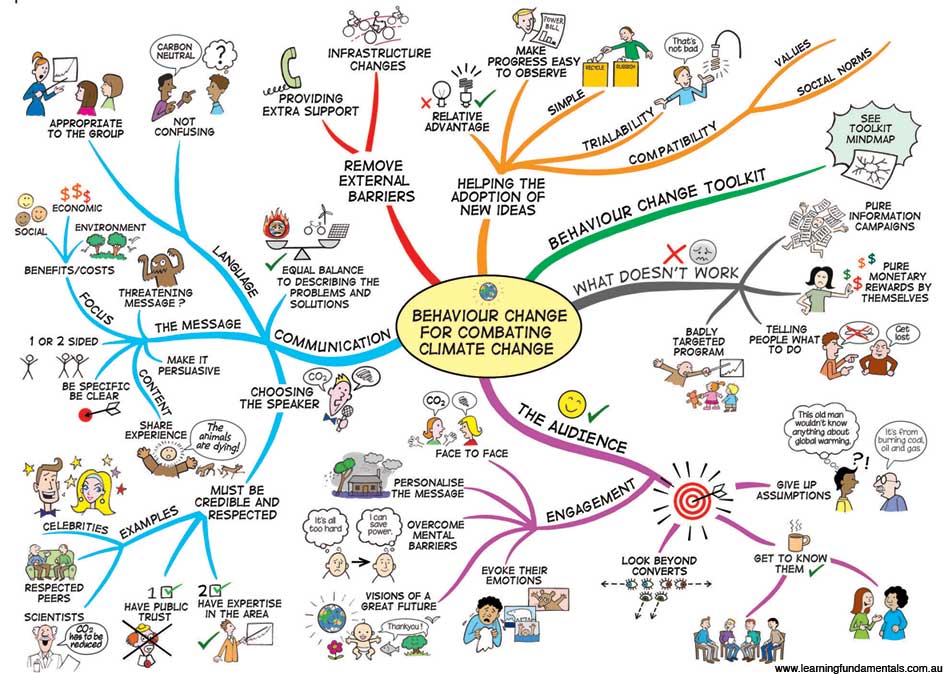
How to create climate friendly behaviour change among staff, beneficiaries, volunteers, customers and the wider public.
To state the obvious, environmental behaviour change is about changing people’s behaviour and attitude towards the environment. This can be as basic as helping to shift attitudes towards the climate or as difficult as challenging people on car use or how often they fly.
Despite the common perception, raising awareness is not the same as achieving behaviour change. Most people in the UK, for example, know that they should be getting at least 5 portions of fruit and veg a day, but few people actually do. Awareness raising is a necessary but not a sufficient condition for achieving behaviour change.
For this reason behaviour change projects are a big step up from simply raising awareness. Developing and delivering a project aimed at engaging an audience or achieving climate friendly behaviour change means having very clear and achievable behaviour in mind, understanding the intended audience and why they behave
the way they do, developing the appropriate interventions from the behaviour change toolkit, and then packaging it all together into a project that is engaging and dynamic.
At Net Zero South Wales the latest science and successes on behaviour change are utilised to develop the most effective and innovative projects. A variety of tools, such as the Kubler-Ross curve, the Behaviour Change Wheel, the six ‘levers’ of behaviour change and models of how behaviour diffuses through a population are used to develop the best project for your needs.
If your organisation is thinking about developing a project to raise awareness or to encourage climate friendly behaviour then we suggest that you take advantage of our free 1hr consultation to find out how we may be able to help and in the meantime look at our guidelines to get an idea as to the cost and types of support we can offer.
‘A big focus on developing cutting edge and innovate behaviour change projects.‘
FAQs
How do you go about developing a behaviour change project from scratch?
After an initial enquiry has been made we will seek to arrange a meeting in order to clarify the type of behaviour change you are looking to achieve, the intended audience, the budget you have in mind, what has previously been done, and any other relevant information such as available staff or volunteers, details of infrastructure and environmental policies, and so on. We will then go away and based on those initial discussions develop one or more potential project outlines and ideas for how this can be achieved. We will then look to arrange another meeting at which these draft project outlines can be discussed and refined. The developmental process continues this way in an iterative fashion until you are happy that you have got the project that you want and that it is set up to achieve the outcome you desire.
Can you just give us some advice on how to improve our existing project?
Yes, we can provide a few hours of time to give you valuable advice at very little expense on your existing project. For a brief overview and explanation of the kind of advice and support we can offer download our guidelines here: Behaviour change guidelines.
How much will developing a behaviour change project to engage our staff cost?
For an overview and explanation of our pricing structure you can download our guidelines here: Behaviour change pricing guidelines.
How long does a behaviour change project take?
That depends upon a lot of factors but 6 months is perhaps a typical length of time, together with some extra provision made for some kind of follow up work a year or so after the end of the initial period in order to encourage the embedding of the new behaviour.
How successful are behaviour change projects?
That is a very complex question to answer for a whole host of reasons, but the long and short of it is that for organisations on a budget a well designed behaviour change project may be expected to impact the behaviour of around 10 to 20% of staff.
For example, recent developments by a behaviour change research group were taken up by a large supermarket chain in order to encourage more vegan foods to be purchased in their cafeterias. They applied ‘decision tree’ methods from the ‘six levers’ model of behaviour change to alter their menus without making any other changes, and by this were able to increase the sales of vegan foods by 15-25%.
What clients have you worked with before?
Net Zero South Wales was launched in 2025 and so does not yet have a long resume of client organisations. The founder of Net Zero South Wales however has nearly 20 years of experience in developing and managing behaviour change projects and has worked with a wide variety of clients such as local and national authorities, charities and community groups.